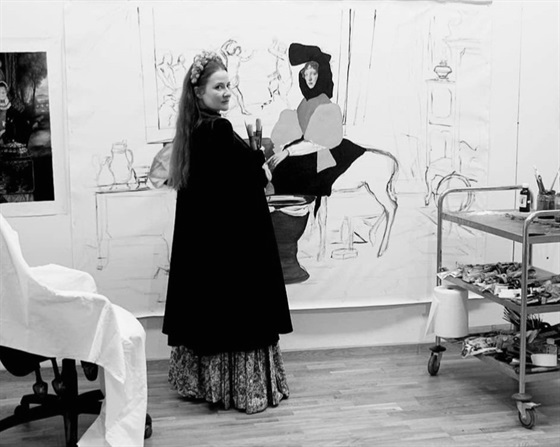
W.ONESPACE is honored to present “The Other Table”, the first solo exhibition in China of Romanian artist Teodora Axente. Continuing the surrealist trajectory of her dual exhibition Scène Noire in 2023, this presentation gathers nearly a year of her latest painterly explorations. Centered on the theme “metamorphosis”, the works unfold through three intertwined perspectives - still life, landscape, and bodily transformation, constructing a visual realm suspended between the material and the spiritual. At the hidden origin of this world lies the conceptual threshold named “the other table”.
As a piece of domestic furniture, table has its structural origin in ancient traditions of elevated seating. Over time, as this format gradually became secularized, the table evolved into a tool mediating ritual and social behavior—delineating a spatial site where ceremony, sharing, negotiation and knowledge formation take place. From altar to dining table, from negotiation table to writing desk, it continually participates in humanity’s construction of order and power, of self and other. In Axente’s practice, she deliberately removes the social bodies seated at the “one table”, erasing the human interlocutors once engaged in exchange. Through this absence, the abstracted “the other table” emerges as a metaphor for another order, an opening where metamorphosis becomes possible.
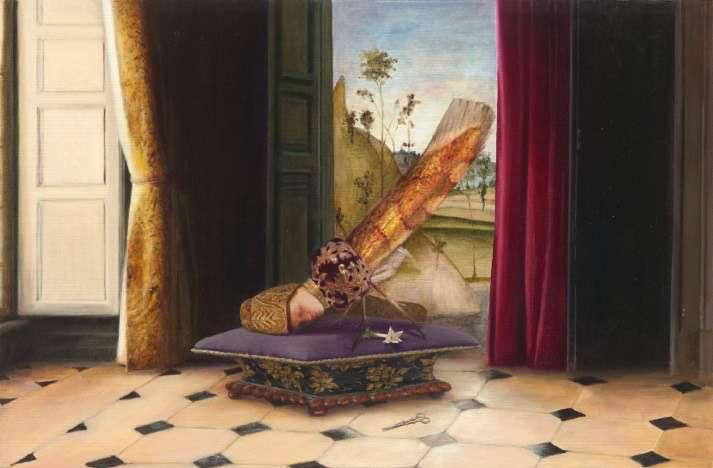
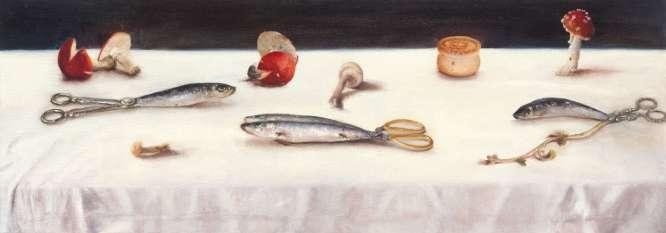
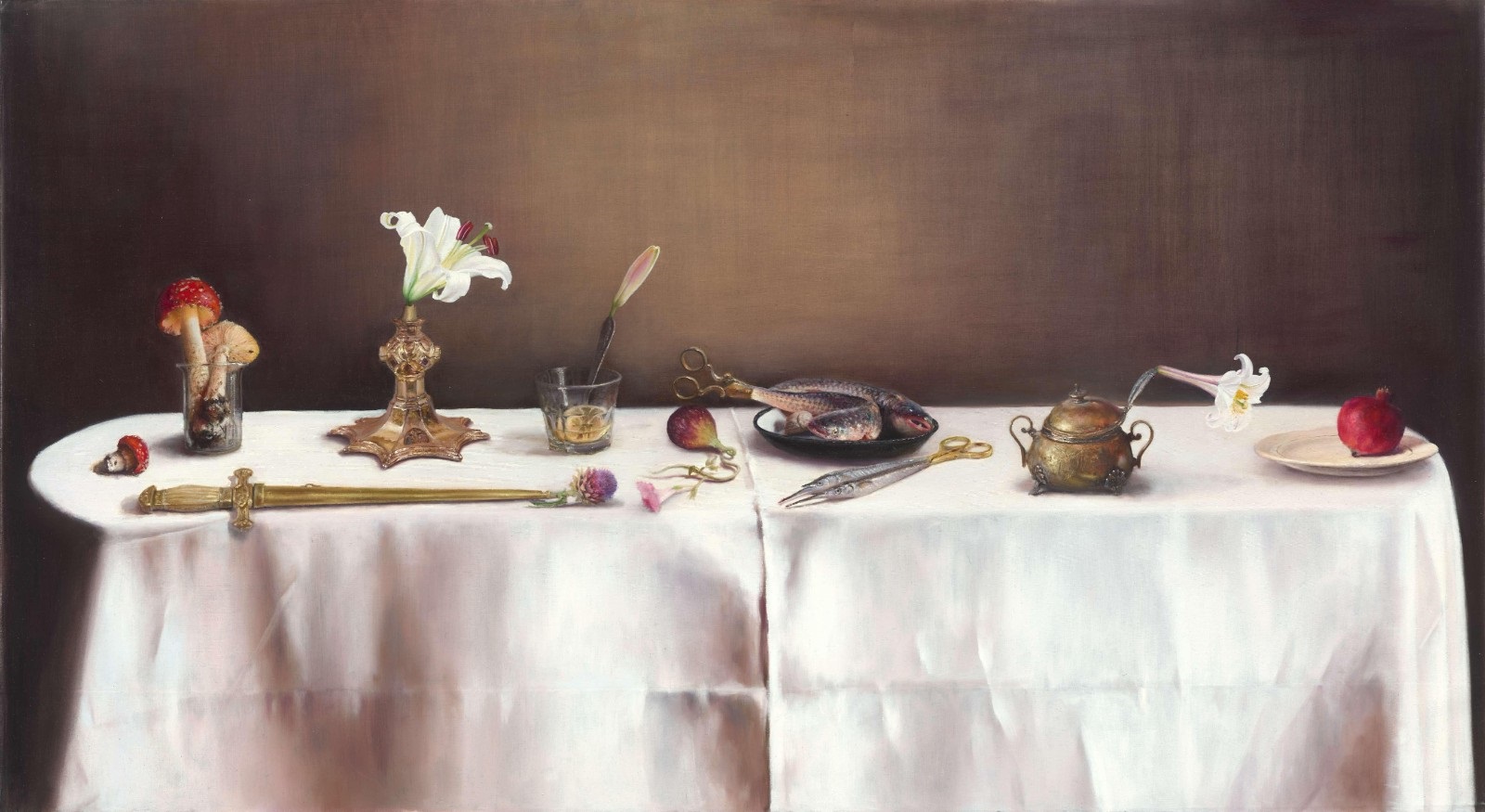
In new works, the tabletop extends beyond the horizon, becoming an entry point into a realm unreachable from reality’s edge. Somewhere beyond the visible frame, the seating is redistributed. In Axente’s paintings, white cloths and dark backgrounds elevate metallic utensils as they begin their transformation into living forms: a chalice blossoms into lilies, a spoon handle becomes a lotus bud, and the twin blades of a pair of scissors elongate into two fish.
These mutations echo symbolic steps toward the divine within religious allegorical systems, forming a concealed ritual unfolding atopthe second table—a gesture of homage to the sacred motif of The Last Supper. Through the language of the table, Axente evokes the ideals of communion, dialogue, and unity.
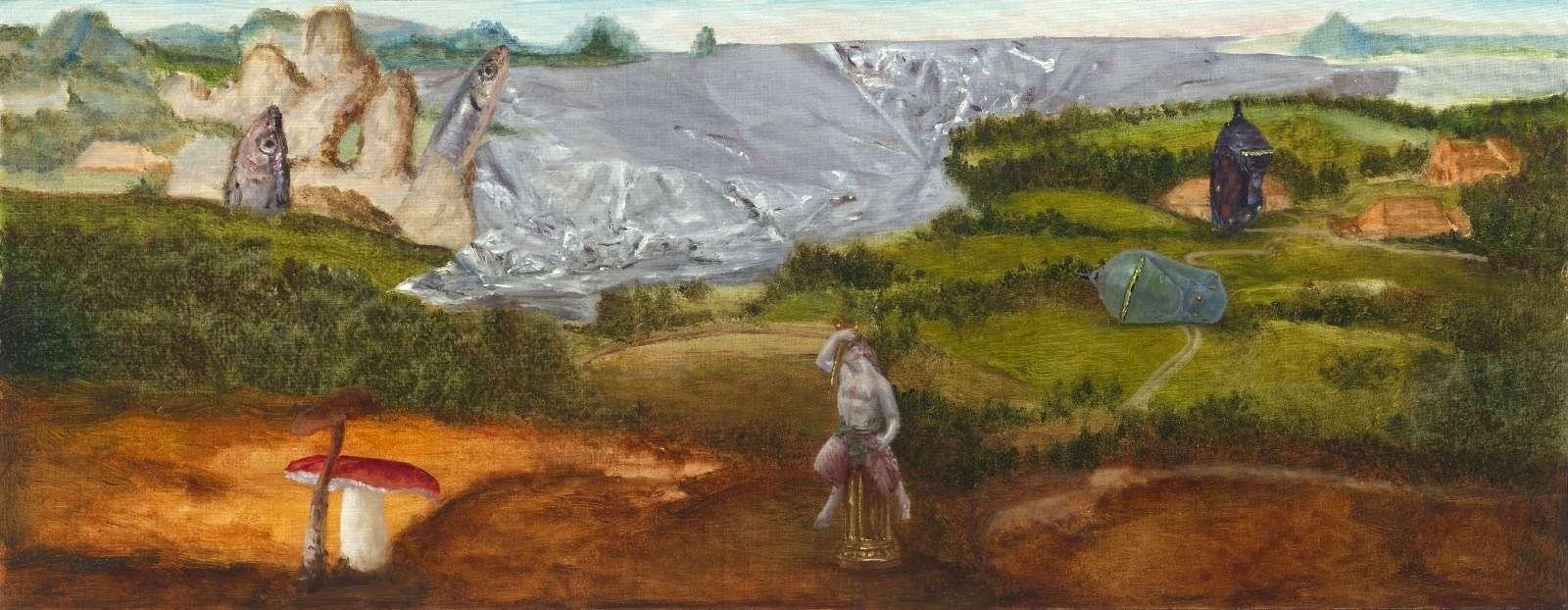
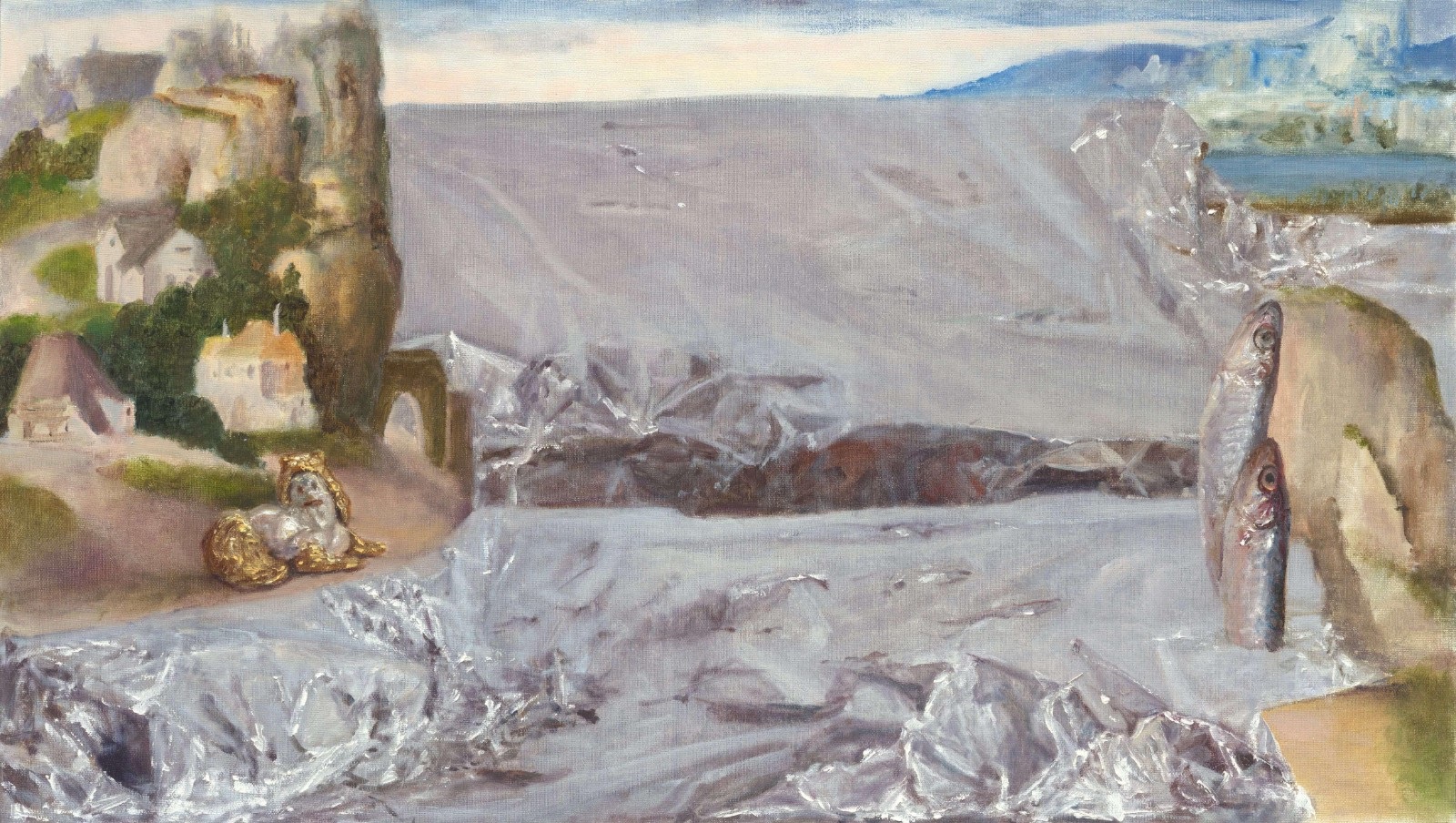
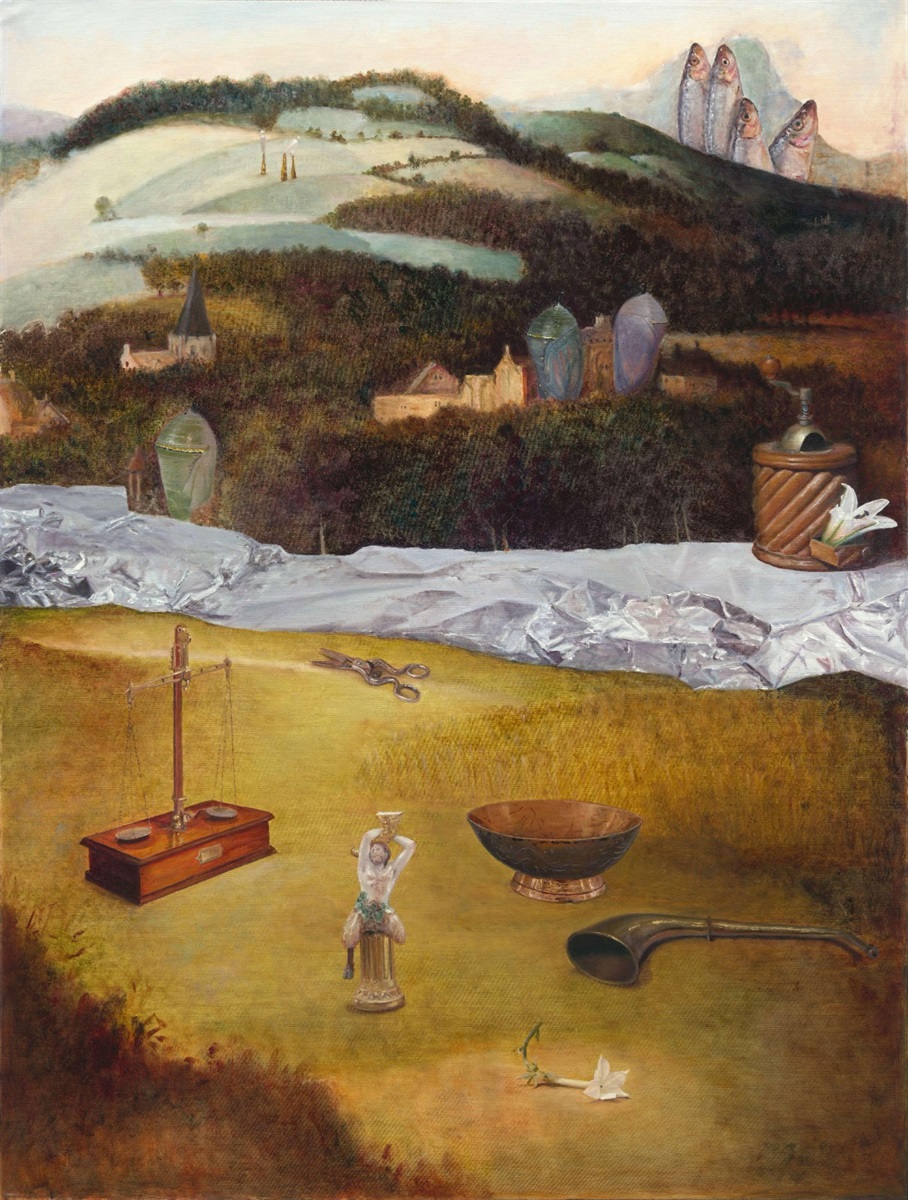
At the same time, Axente adopts elongated horizontal compositions, extending the tabletop’s line into the foreground of the landscape, like a fragment torn from a traditional scroll. Yet unlike the continuous shifting perspective of classical panoramic vision, her intent is not to construct narrative logic. Instead, she tears open a fragment of a daydream, revealing mountains, light, and objects caught in a slow state of transformation. Multiple horizons unfold across the canvas. Opposite the mountains, the water’s surface is rendered in shining metallic foil—a restless sea absorbing the anxieties and tensions of living beings. Its crumpled texture resembles a disturbed mirror reflecting the shadows of life and the outlines of desire. Within this fantastical, surreal terrain, day and night, life and death, the known and the unknown overlap endlessly, forming a perpetual state of transition.
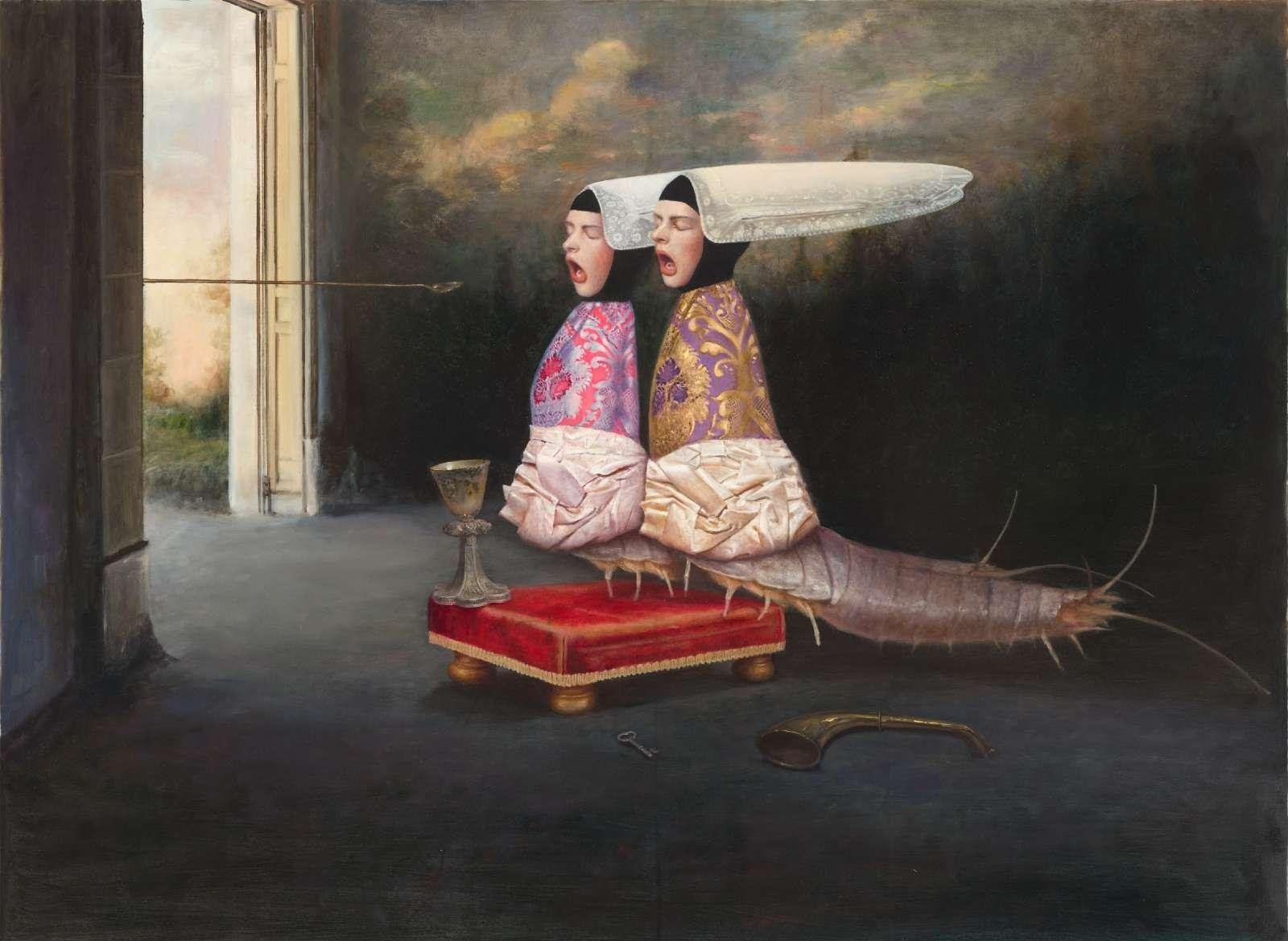
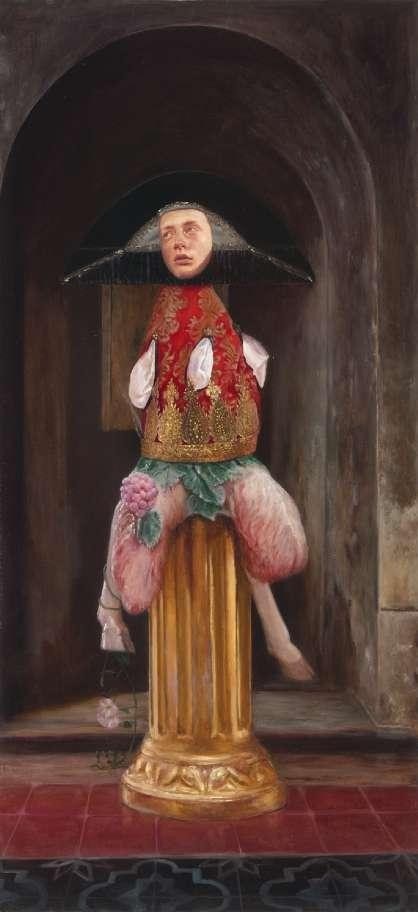
Within the paintings, transformation occurs at the table, the process of complete metamorphosis in insects becomes a new reference pathway for Axente’s visual translation. Her earlier exploration of the relationship between humans and animals shifts subtly toward the relationship between humans and insects. In works such as Eucharistic and In Pray, the figures receive spiritual nourishment through communion and prayer, advancing gradually toward a heightened state of being. This passage becomes an invisible axis extending from the tabletop. Symbols of pride and spiritual danger—poisonous mushrooms and statues occupy the foreground as warnings. Fish, lilies, and scissors correspond to taste, sight, and smell: three senses that occupy the middle and distant ground, surveying the scene and pointing toward the presence of the sacred.
In the context of contemporary painting, the ancient sacrifice embedded in Eucharistic ritual becomes a gesture of offering and sharing upon an everyday table. To reconstruct this classical motif is not merely to redistribute food - it is to reexamine position, boundary, and relational structure. Axente’s the other tablemarks the coexistence of two worlds: one table inscribes the order of reality, while the other directs us toward imagination, myth, belief, and inner transformation. By placing overlooked objects at the center of “the other table”, artist attempts to reorder the world. Upon this unoccupied table, unfinished rituals resurface. It is precisely within these silent intervals - in the absence of human voices, metamorphosis takes place quietly.
This exhibition is on until January 18, 2026.
As a piece of domestic furniture, table has its structural origin in ancient traditions of elevated seating. Over time, as this format gradually became secularized, the table evolved into a tool mediating ritual and social behavior—delineating a spatial site where ceremony, sharing, negotiation and knowledge formation take place. From altar to dining table, from negotiation table to writing desk, it continually participates in humanity’s construction of order and power, of self and other. In Axente’s practice, she deliberately removes the social bodies seated at the “one table”, erasing the human interlocutors once engaged in exchange. Through this absence, the abstracted “the other table” emerges as a metaphor for another order, an opening where metamorphosis becomes possible.
In new works, the tabletop extends beyond the horizon, becoming an entry point into a realm unreachable from reality’s edge. Somewhere beyond the visible frame, the seating is redistributed. In Axente’s paintings, white cloths and dark backgrounds elevate metallic utensils as they begin their transformation into living forms: a chalice blossoms into lilies, a spoon handle becomes a lotus bud, and the twin blades of a pair of scissors elongate into two fish.
These mutations echo symbolic steps toward the divine within religious allegorical systems, forming a concealed ritual unfolding atopthe second table—a gesture of homage to the sacred motif of The Last Supper. Through the language of the table, Axente evokes the ideals of communion, dialogue, and unity.
At the same time, Axente adopts elongated horizontal compositions, extending the tabletop’s line into the foreground of the landscape, like a fragment torn from a traditional scroll. Yet unlike the continuous shifting perspective of classical panoramic vision, her intent is not to construct narrative logic. Instead, she tears open a fragment of a daydream, revealing mountains, light, and objects caught in a slow state of transformation. Multiple horizons unfold across the canvas. Opposite the mountains, the water’s surface is rendered in shining metallic foil—a restless sea absorbing the anxieties and tensions of living beings. Its crumpled texture resembles a disturbed mirror reflecting the shadows of life and the outlines of desire. Within this fantastical, surreal terrain, day and night, life and death, the known and the unknown overlap endlessly, forming a perpetual state of transition.
Within the paintings, transformation occurs at the table, the process of complete metamorphosis in insects becomes a new reference pathway for Axente’s visual translation. Her earlier exploration of the relationship between humans and animals shifts subtly toward the relationship between humans and insects. In works such as Eucharistic and In Pray, the figures receive spiritual nourishment through communion and prayer, advancing gradually toward a heightened state of being. This passage becomes an invisible axis extending from the tabletop. Symbols of pride and spiritual danger—poisonous mushrooms and statues occupy the foreground as warnings. Fish, lilies, and scissors correspond to taste, sight, and smell: three senses that occupy the middle and distant ground, surveying the scene and pointing toward the presence of the sacred.
In the context of contemporary painting, the ancient sacrifice embedded in Eucharistic ritual becomes a gesture of offering and sharing upon an everyday table. To reconstruct this classical motif is not merely to redistribute food - it is to reexamine position, boundary, and relational structure. Axente’s the other tablemarks the coexistence of two worlds: one table inscribes the order of reality, while the other directs us toward imagination, myth, belief, and inner transformation. By placing overlooked objects at the center of “the other table”, artist attempts to reorder the world. Upon this unoccupied table, unfinished rituals resurface. It is precisely within these silent intervals - in the absence of human voices, metamorphosis takes place quietly.
This exhibition is on until January 18, 2026.